Into the NOW: Living Beyond the Illusion of Linear Time
What if time isn't the fixed, linear force we've always assumed it to be? What if time, itself, is a clever illusion, one that science has been quietly dismantling for over a century?
From Einstein's Theory of Relativity to the timeless behavior of subatomic particles in quantum mechanics, the evidence suggests that time as we experience it is far more fluid, malleable, and subjective than our clocks would have us believe.
In this post, we're exploring the science behind the illusion of linear time, what it means for how we live, and how we can develop a more empowered, present-moment relationship with time that frees us rather than imprisons us.

“Clocks are very useful for telling time. But they also conspire to keep us from knowing the truth about time.”
here’s what you’ll learn in this article:
Why Einstein's Theory of Relativity dismantled the idea of time as a fixed, universal constant, and what gravitational time dilation reveals about the deeply relative and illusory nature of linear time.
What quantum mechanics adds to our understanding of time, including how subatomic particles operate entirely outside the bounds of space and time, and what the holographic model of the universe suggests about the nature of past, present, and future.
How our own state of consciousness shapes the way we experience time, what it looks like to live in empowered relationship with the present moment Now, and practical ways to begin releasing the mind's grip on the illusion of linear time.
🎙 If you prefer to listen instead, click here to access the podcast episode.
Table of Contents
Time Is Relative: Questioning the Reality of Linear Time
Einstein's Theory of General Relativity
Gravitational Time Dilation
Density and the Illusion of Time
Time Is Quantum and Holographic
Quantum Entanglement and the Field of No-Time and No-Space
Quantum Timelessness
The Holographic Model of Time
Time Is Subjective: Dependent on Our State of Consciousness
Is Time Simply Attention?
Flow Time
Living in the Empowered Point of Now
Using Time to Our Detriment vs. Our Empowerment
Signs We're Out of the Now Moment
Ways We Lock Ourselves Out of the Now Moment
Signs We're Living in Empowered Time
Ways to Center Into the Now Moment

Time Is Relative: Questioning the Reality of Linear Time
"It might well be that every moment of our lives influences every other moment, forward and backward."
—Lynn McTaggart, The Field
Einstein's Theory of General Relativity
If you've seen the movie Interstellar, you know that time is a peculiar thing. In one of the film's most memorable moments, Anne Hathaway's character reminds Matthew McConaughey's that seven years on Earth will pass for every hour they spend on the distant planet they're investigating. And when they return to their space station after just three hours on that planet, the person who stayed behind is 21 years older.
This isn't Hollywood fiction. It's reality and it’s physics.
Einstein's Theory of Relativity dismantled the Newtonian idea that time is absolute and unidirectional, moving forward like an arrow. Relativity demonstrates that time varies with velocity, passing more slowly the faster you're moving. However, to a stationary observer, time would pass quicker.
Time bends and changes relative to its spatial relationship with gravitational forces. The more gravity, the more speed. And the speed of pure gravity is the speed of light itself.
Newtonian physics viewed time as a straight arrow, but Relativity views time as part of a dimensional fabric woven from both time and space. This is why Einstein identified them together as a single additional dimension known as space-time.
As Chopra and Kafatos explain in You Are the Universe, time "is affected by an observer's frame of reference and also by being close to a strong gravitational field. This is known as time dilation."
Gravitational Time Dilation
What this means practically is that different observers in the universe will have different calculations of time depending on their velocity and proximity to gravitational fields. Clocks positioned near a stronger gravitational field run slower than clocks positioned near a weaker one. Less time elapses near a strong gravitational field than in a location with weaker gravity.
Here's the strange part though: the experience of time feels identical in both locations.
A person existing near a stronger gravitational field doesn't feel as if time is moving slower. Time feels perfectly normal to her. And a person existing near a weaker gravitational field doesn't feel as if time is moving faster. Time feels normal to her too. In fact, these two individuals would be none the wiser about their time discrepancy unless they met up and compared clocks, at which point they might discover that only one day had passed for one person while ten full years had passed for the other.
What does this tell us? It tells us that the experience of time is an illusion. What's “the future” to one observer is “the past” to another, depending entirely on where they're positioned in relation to one another along the space-time continuum.
This isn't just a theoretical curiosity either. GPS satellites, for instance, have to have their clocks adjusted to match Earth time because the reduced gravitational pull at their distance from Earth causes them to naturally run faster than clocks on the ground.
As Einstein himself put it:
"I have realized that the past and future are real illusions, that they exist in the present, which is what there is and all there is."
Density and the Illusion of Time
Here's something fascinating to sit with: it's actually the densification of matter that induces the experience of linear time.
Only particles with zero mass, like photons, can move at the speed of light. And according to Relativity, moving at the speed of light slows time to a complete standstill. So for photons, the subatomic particles of light, time stands still in the ever-present, timeless state of the here and now.
Our human bodies, of course, have measurable mass. So we move slower than the speed of light and therefore experience linear time.
According to Relativity, nothing with a finite mass can ever reach the speed of light. But here's an intriguing thought: if something were able to move faster than the speed of light, it would actually move backwards in time, experiencing both time reversal and age reversal.
Makes you wonder what was really in that legendary Fountain of Youth, doesn't it?
But can anything actually move faster than the speed of light? The answer depends on whether we turn to Relativity or Quantum Mechanics for the response.
Let’s take a look at what quantum mechanics has to say about time…
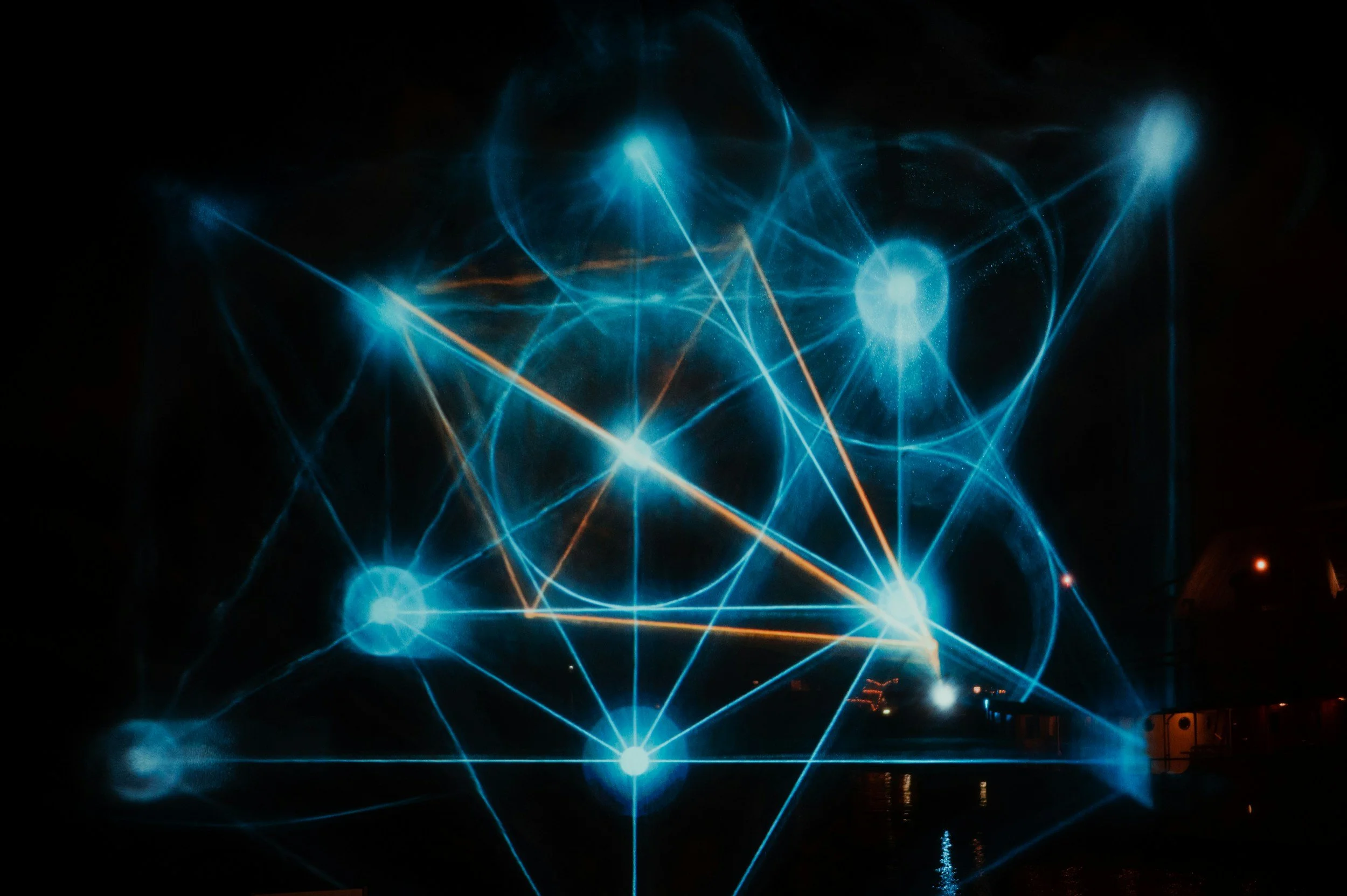
Time Is Quantum and Holographic
Quantum Entanglement and the Field of No-Time and No-Space
Quantum mechanics, which accurately describes the behavior of the very small things in our universe, has a rather different relationship with time than Relativity does. And this is where things get interesting.
The phenomenon of quantum entanglement, famously described by Einstein as "spooky action at a distance," puts time and space to the test in a profound way.
When two particles are entangled,a state change in one is instantaneously mirrored by the other, regardless of the distance between them. There's no delay. No travel time. The response is immediate, no matter how far apart the particles are.
If we try to understand this through the lens of Relativity, we'd have to assume that information is somehow being communicated between the two particles faster than the speed of light, which Relativity says is impossible. This is precisely what left Einstein so unsettled about quantum entanglement.
But looking at the quantum world through a relativistic lens isn't particularly useful, because the quantum world plays by different rules entirely.
At the quantum level, subatomic particles don't actually traverse across space the way we'd expect. Rather than moving in the traditional sense, they wink in and out of existence entirely, paying no attention to space or time whatsoever. This is what's known as a quantum leap or quantum jump.
Yes, quantum leaps are a real thing.
Subatomic particles appear, disappear, and then reappear in a completely different location without traversing the spatial distance in between. They're here one instant, gone the next, and then suddenly over there without ever having crossed the space between.
As Chopra and Kafatos put it,
"…the subatomic particles bring space and time with them."
The phenomenon of quantum entanglement suggests that the transfer of information between entangled particles occurs entirely outside the bounds of space and time. It's not using the space-time continuum to travel at all. It's closer to what we might call teleportation, which at the quantum level means transmitting the state of a thing rather than sending the thing itself.
Quantum Timelessness
At the quantum level, time doesn't "flow" in any meaningful sense. Flow implies continuous movement, and continuous movement doesn't exist at the subatomic level. Particles wink in and out of existence, appearing and reappearing in different positions without any observable movement between them.
And yet at the macro level, our minds stitch together these individual "on" snapshots of the physical world in a way that makes reality appear continuous and linear.
The seamless movie we call life is actually a rapid series of quantum frames, assembled by the mind into the illusion of flow.
The Holographic Model of Time
The holographic model of the universe takes this understanding of time even further…
In a holographic universe, everything is inherently interconnected and all of it is happening now. The past doesn't cease to exist when it becomes the past. Rather, it's enfolded back into what physicist David Bohm called the "implicate order," a kind of cosmic storehouse of all that has ever unfolded.
As Michael Talbot writes in The Holographic Universe,
“If, as Bohm suggests, consciousness also has its source in the implicate, this means that the human mind and the holographic record of the past already exist in the same domain, are, in a manner of speaking, already neighbors. Thus, a shift in the focus of one’s attention may be all that is needed to access the past.”
He continues:
"The record of the past does not appear to be stored at any one location, but like the information in a hologram, it is nonlocal and can be accessed from any point in the space-time framework."
A holographic model of reality makes possible phenomena like clairvoyance, precognition, retrocognition, and psychometry, because all past and future times are inherently accessible from within the precision of the Now moment. It's simply a matter of retuning the consciousness frequency dial.
So where does all of this leave us with regard to the reality of time?
According to Relativity, time is an illusion because it's relative rather than absolute.
According to Quantum Mechanics, the small stuff of our universe operates entirely outside the bounds of space and time. And yet we experience life as if we're moving forward on a linear arrow of time.
The truth seems to be that time is a measurement we use to quantify change. And how we experience it depends enormously on something much more intimate than physics…

Time Is Subjective: Dependent on Our State of Consciousness
Is Time Simply Attention?
The discussion of time isn't purely a matter of physics. It's also a philosophical and psychological one.
As Relativity demonstrates, time isn't a constant. It's fluid and malleable. But its malleability isn't only dependent on gravity and speed. The way we experience time is also deeply shaped by our state of consciousness. Time isn't just relative. It's also highly subjective and personal.
Einstein hinted at this when he famously remarked:
"Put your hand on a hot stove for a minute, and it seems like an hour. Sit with a pretty girl for an hour, and it seems like a minute. That's relativity."
Here's an idea worth sitting with: what if time is simply attention?
It seems that the more we resist the present moment by projecting our attention away from it, either back into the past or forward into the future, the more fixed and rigid time becomes. On the other hand, the more fully we inhabit the present moment Now, the more malleable our experience of time becomes.
In other words, the further our mind wanders from here and now, the more time-aware we become and the more bound by it we feel. But in moments when our awareness is fully attuned to the present moment, we pay almost no mind to time at all. And in those moments, we experience something that feels remarkably like timelessness.
Flow Time
States of cognitive flow are a perfect example of this. When we're in a state of flow, we're not aware of time passing because we're so deeply immersed in the Now moment experience of what we're doing. Time ceases to be relevant.
It's only once we pop out of flow and glance at the clock that time becomes relevant again. In noticing it, we've re-anchored our awareness to a definitive point along the linear space-time continuum.
When we're at one with the Now moment, we don't experience time the way we do when we're resisting it. In fact, in those moments of true presence, we don't really experience time at all.

Living in the Empowered Point of Now
Using Time to Our Detriment vs. Using Time to Our Empowerment
It's freeing to recognize that time itself is a multifaceted illusion. And yet practically speaking, living on this planet does require that we play by the rules of linear time to some degree.
As Chopra and Kafatos acknowledge,
"…to accept that the past and the future are illusions would disrupt a world that runs on the assumption that the passage of time is totally real."
The question isn't whether we participate in linear time. We have to. The question is how we choose to relate to time.
We can think about our relationship with time as existing on a spectrum.
On one end of the spectrum, there’s a rigid way to relate to time. This is what we might call the Militant relationship with time. Here, we become a slave to the clock, overvaluing time in a frantic attempt to control it. Ironically, the more we tether our attention to linear time, the more time binds us and the less freedom we actually have.
At the other end of the spectrum is what we might call the Reckless relationship with time, in which we disregard it so completely that we invite chaos and consequence into our lives.
The sweet spot is somewhere in the middle—what we might call the Empowered relationship with time. Here, we strike a fluid and freeing balance between honoring our time-related responsibilities and existing in the unbound freedom of the Now moment. Paradoxically, it's this empowered middle-ground relationship with time that frees us to live most fully in the present.
Signs We're Out of the Now Moment
Here are some of the most common signs that we're relating to time in a disempowering way:
We race, rush, and hurry through our days, feeling as if it's us against the clock and there aren't enough hours.
We procrastinate and waste time because we overvalue future time and undervalue the present, believing that some moment off in the future will be more apt for our attention than this one.
We worry about what's coming and fret about what's already passed, draining the present moment of its power.
We relive past moments on repeat and "what if" the future.
We resist the impermanent nature of reality, greeting change with anxiety and digging our heels in against anything that arrives outside of our control.
Ways We Lock Ourselves Out of the Now Moment
We search outward for what can only be found within. We look for peace, fulfillment, and meaning everywhere but here and now, and in doing so, the Now moment persistently eludes us. It's in the cessation of seeking elsewhere that the fullness of Now finally reveals itself.
We also allow the mind to drift constantly into the past and future without ever noticing that it's drifting. And here's the thing: the drifting itself isn't the problem. That's the ego's normal set point. The problem is failing to notice it. We don't notice the drift when we're overvaluing linear time, because when we're focused on what was or what might be, we're undervaluing what's right here. And the only way to catch the drift is to first recognize the extraordinary value of this present moment, right now.
Signs We're Living in Empowered Time
When we're in a genuinely empowered relationship with the present moment, we know it. Here's what it feels like:
We experience a sense of timelessness, the kind of flow where hours feel like minutes.
Our past regrets and future worries fall away without effort.
We embrace impermanence, allowing change to unfold without fighting it, even when it's uncomfortable.
We feel both a soothing stillness and a vivid aliveness simultaneously.
We trust that life is unfolding for us rather than happening to us.
We surrender to the natural flow of life without needing to control its direction.
We experience what can only be described as time abundance, a genuine knowing that there's always enough time.
Ways to Center Into the Now Moment
Here’s the tricky thing… there's no checklist for getting to the Now. Trying too hard to find the present moment causes it to slip right through our fingers.
We can't think our way to Now. We can't strategize our way there either.
We access the fullness of Now by allowing it.
As Deepak Chopra writes in The Book of Secrets,
"You have to be sober before you can be ecstatic... What you're hunting for, call it presence, the now, or ecstasy, is totally out of reach. You cannot hunt it down, chase after it, command it, or persuade it to come to you."
And then he offers this gem:
"There is nothing to do. Presence will appear on its own, and when it does, your awareness cannot help but be in the now... The best use of time is to reconnect to your being. The misuse of time comes down to the opposite: moving away from your being."
What this looks like in practice is a gentle, moment-by-moment returning…
We notice when the mind has drifted. We bring it back, without judgment. We release the agenda. We stop hunting for stillness and allow it to find us.
And we do this again and again, day after day, until we find ourselves naturally shifting closer and closer to the center point of this Now moment, not as a destination we've finally reached, but as a way of being we've learned to inhabit.
Because the present moment isn't a milestone off in the distance. It's right here. It always has been.
Final Thoughts
Linear time is one of the most convincing illusions we inhabit as human beings. And yet the science, from Relativity to quantum mechanics to the holographic model of the universe, keeps pointing to the same quiet truth: the present moment isn't a fleeting space sandwiched between past and future. It's the only moment that ever really exists.
We don't have to wait for science to fully unravel the mystery of time before we start relating to it differently. We can begin right now, in this moment, by gently loosening our grip on the clock and trusting that the present moment holds everything we need.
As Einstein noted,
"I have realized that the past and future are real illusions, that they exist in the present, which is what there is and all there is."
That's not a limitation, it’s an invitation.
References and Further Reading
Books
Chopra, D. (2004). The Book of Secrets: Unlocking the Hidden Dimensions of Your Life. Harmony Books.
Chopra, D. (2019). Metahuman: Unleashing Your Infinite Potential. Harmony Books.
Chopra, D. and Kafatos, M. (2017). You Are the Universe: Discovering Your Cosmic Self and Why It Matters.Harmony Books.
McTaggart, L. (2002). The Field: The Quest for the Secret Force of the Universe. HarperCollins.
Talbot, M. (1991). The Holographic Universe. HarperCollins.
Articles
Teleportation: Photon particles today, humans tomorrow?
Visualizing the mysterious dance: Quantum entanglement of photons captured in real-time (entangled photons look like the yin-yang symbol)
Interstellar’s Time Dilation Explained: Why Time Moves Slower On Miller’s Planet
How Gravity Changes Time: The Effect Known as Gravitational Time Dilation
Time Dilation: Why Does Gravity Slow Down The Flow Of Time?
